From the announcement and the store images
What the sequel materials describe
HUMANKIND 2, still unreleased, has been pitched as a deeper cultural journey, a map reshaped by climate, and an empire of cities and armies carried from early settlements into the Modern Age. This page reports that pitch, then the labels that can be read on official Steam screenshots. It does not fill in rules the materials never state.
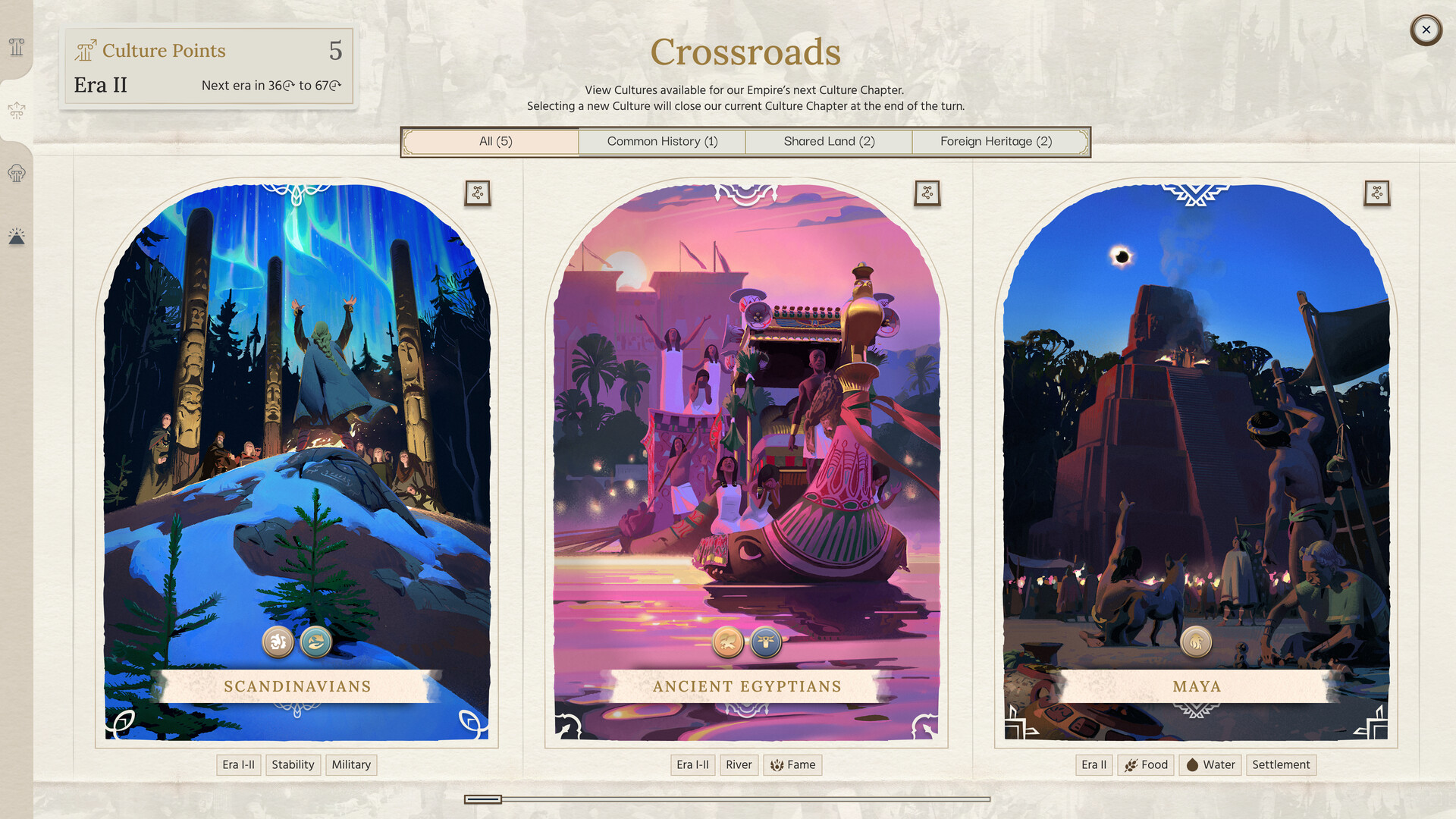
Cultures, eras, and a screen called Crossroads
The press release says cultural evolution is reimagined for the sequel. With each new era, a player can adopt a culture that expands the identity of a civilization and unlocks exclusive customs through cultural progression trees. Combined influences are meant to produce a civilization with more personalization, consistency, and continuity across the ages. The same text says each evolution can follow the historical path or diverge from it.
The Steam about-text matches that outline and names examples of new stories: the Saqqaq, the Etruscans, the Scythians, "and many more." Those three names are examples in a sentence, not a roster. The community post adds that customs are shaped from ancestral heritage and the environment.
One official screenshot goes further, and only as far as its labels. The screen is titled Crossroads. A panel reads Era II and shows Culture Points with the value 5 on this image. Beside that, a line reads "Next era in 36" and "to 67," with a small mark after each number. The mark is not spelled out, so this guide does not name a unit. Two sentences on the screen are explicit:
- "View Cultures available for our Empire's next Culture Chapter."
- "Selecting a new Culture will close our current Culture Chapter at the end of the turn."
Filters on the same screen read All (5), Common History (1), Shared Land (2), and Foreign Heritage (2). The three cards in view are Scandinavians, tagged Era I-II, Stability, and Military; Ancient Egyptians, tagged Era I-II, River, and Fame; and Maya, tagged Era II, Food, Water, and Settlement. This page names those tags because they are printed on the cards. It does not define what Stability, Fame, Food, or the other words do in play. The All count of 5 means two cultures on that screen are not readable in the frame. Their names are not guessed here.
A Steam event on 15 October 2026 is subtitled "Follow the Ancient Egyptians through the early game." That subtitle lines up with the Ancient Egyptians card. It still does not publish the rest of a culture list. Saqqaq, Etruscans, and Scythians remain announcement examples. They are not automatically the two unread cards.
Climate and the map
Both the press release and the Steam description say a changing climate transforms the strategic map across the ages. The published verbs are specific and limited: adapt cities and an economy to shifting biomes, protect vital resources, and weigh short-term growth against consequences that can last for generations. Steam's closing line asks whether nature's gifts will be used or will fade, and it calls Mother Nature either an ally or an obstacle. The community post says to make the most of what Mother Earth provides.
That is the climate system as far as the text goes. The materials used here do not publish a temperature model, a disaster list, a pollution dial, or a rule for how a biome flips. Official screenshots do show very different landscapes side by side: a polar coast, a desert city, and green harbors. Those images support the claim that the world is visually varied. They are not a manual for climate rules.
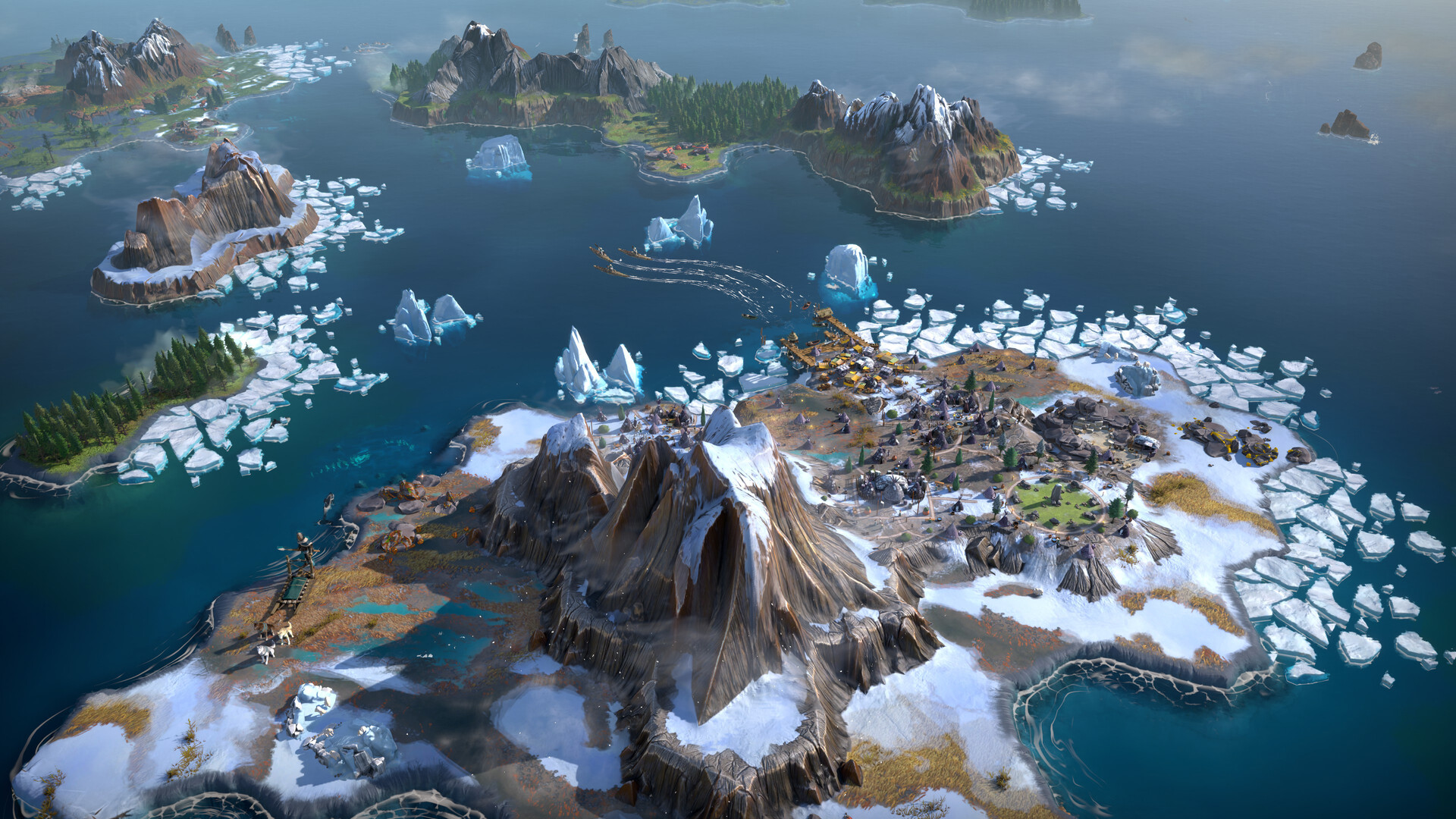
Cities, armies, and the path through history
The shared pitch, on Steam and in the press release, is to found cities, develop technologies, forge alliances, command armies, and move from the earliest settlements to the Modern Age. The community post adds trade with neighbors, or trouble with them, and the work of developing an empire. "Forge alliances" is as detailed as diplomacy gets in the announcement. The community line about trade and trouble is as detailed as conflict gets in that post. No treaty screen, trade good, or combat formula is written out in those texts.
Screenshots show the subjects of that pitch without turning into a rules text. Coastal and desert cities include harbors, monuments, walls, and farmland. Another frame shows groups of infantry, cavalry, and cannon crews in a river canyon, with a walled outpost on a rise. The store page lists videos titled "HUMANKIND 2 - Official Reveal Trailer" and "HUMANKIND 2 - Gameplay Overview Trailer." This guide names those videos. It does not narrate them as if someone here had sat down with a build.
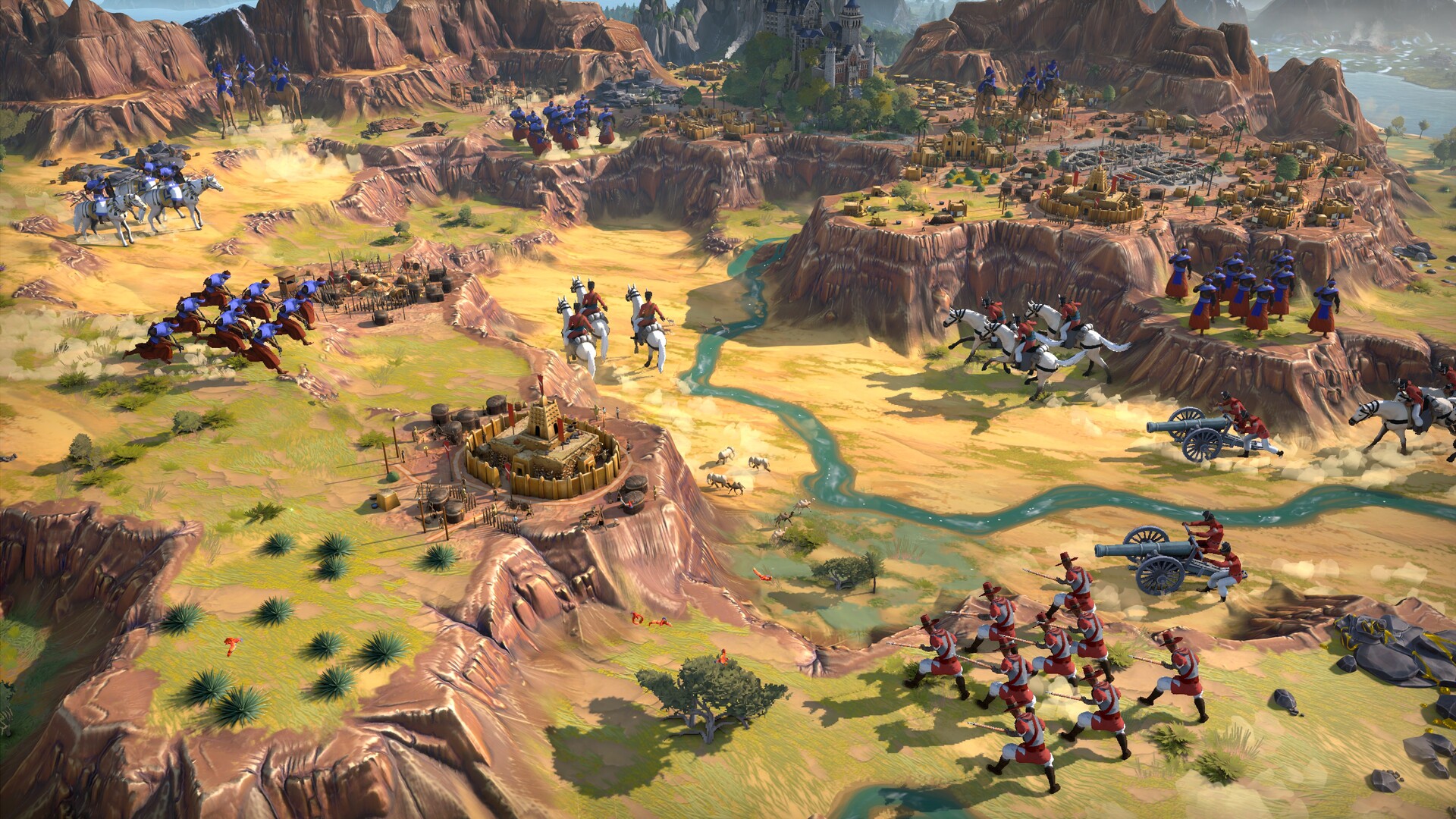
What the studio says is new, without a system list
The press release says the sequel evolves the series past its foundations, drawing on player feedback and on what it calls Amplitude's 15 years of strategy-game experience. It promises new progression systems, features it calls innovative, enhanced visuals, a modernized interface, and gameplay improvements, aimed at "the best HUMANKIND experience to date." Steam's about-text repeats the new progression systems, the visuals, the interface, and improvements guided by player feedback and studio experience.
Those are promises at the level of a reveal. The Culture Chapter flow on the Crossroads screenshot is the one progression surface this guide can point at directly. Other progression systems are acknowledged because the studio says they exist, and they are not described because the studio has not named them in these documents.
The announcement also says Amplitude will keep developing the game with players on the Amplifiers community platform, and that participants can earn unique rewards. The rewards are not itemized in the release.
Not established in these materials
- The full list of cultures, eras, or Culture Chapters.
- How Culture Points are gained or spent. A screenshot shows a value of 5. It does not show a rule.
- What the Crossroads filters Common History, Shared Land, and Foreign Heritage require.
- What the card tags, such as Stability, Military, River, Fame, Food, Water, and Settlement, change.
- Victory conditions, technology trees, diplomacy actions beyond alliances, trade goods, and combat resolution.
- Map size, camera rules, or whether the map is a hex grid. A user tag says Hex Grid. A user tag is not a studio specification.
- Multiplayer structure, beyond Steam's Multi-player label and the note about online interactivity and in-game chat.
- A release day inside 2027, a price, or a review score.
Platform, language, and PC specification details are on the release page. The 2021 game is background on the series page, and it is not used there to invent sequel systems.